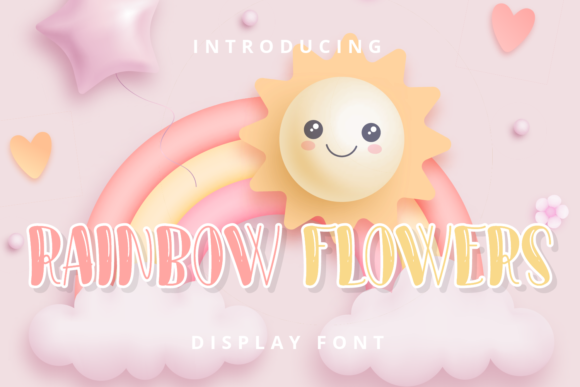
Rainbow Flowers: Integrating a Playful Display Font into Professional and Educational Workflows
In the landscape of digital typography, fonts are rarely just aesthetic choices; they are functional tools that dictate tone, hierarchy, and user engagement. For professionals ranging from educators to marketing managers, selecting the right typeface is a critical step in brand consistency and communication clarity. Rainbow Flowers emerges as a specialized asset within this ecosystem, designed specifically for contexts requiring immediate visual warmth and approachability. While many display fonts strive for modern minimalism or corporate authority, Rainbow Flowers occupies a distinct niche: it is a cute, colorful, and friendly display font that embodies playfulness and authenticity.
This article explores how Rainbow Flowers fits into practical workflows, particularly for children’s activities, school projects, and educational content creation. By understanding its specific attributes—its color palette, its structural friendliness, and its limited but impactful scope—creators can integrate it effectively without compromising overall design integrity or readability.
Understanding the Asset: What Is Rainbow Flowers?
Before integrating any font into a production pipeline, it is essential to understand its technical and emotional characteristics. Rainbow Flowers is not a body text font. It is a display font, meaning its primary function is to capture attention at larger sizes rather than facilitate reading at small sizes. Its defining feature is its inherent coloration; unlike standard monochrome fonts, Rainbow Flowers utilizes a multi-hued palette that mimics the vibrancy of actual flowers.
The font’s personality is defined by two core pillars:
- Playfulness: The letterforms are rounded, soft, and inviting, reducing cognitive friction for young audiences.
- Authenticity: Despite its cartoonish appeal, the font avoids being overly childish or generic. It retains a sense of hand-crafted charm that resonates with both children and adults seeking a genuine, non-corporate connection.
For professionals, recognizing these traits prevents misuse. Using Rainbow Flowers for legal disclaimers or dense data tables would be a workflow error. However, using it for headers, banners, or interactive elements in a learning management system (LMS) aligns perfectly with its intended purpose.
Strategic Placement in Project Lifecycles
Integrating Rainbow Flowers requires planning at different stages of a project. Whether you are an educator designing a classroom poster, a marketer launching a campaign for a toy brand, or a freelancer creating assets for a client in the ed-tech space, the font serves specific roles before, during, and after the creative process.
Pre-Production: Planning and Brand Alignment
During the conceptual phase, the decision to use Rainbow Flowers should be driven by audience analysis. If your target demographic includes children aged 3–10, or if you are creating materials for early childhood education, this font signals safety and fun immediately. In a workflow involving multiple stakeholders, such as a teacher and a graphic designer, establishing Rainbow Flowers as the designated "header" font ensures consistency.
Prepare your style guide early. Define where Rainbow Flowers will appear. Will it be used for slide titles? On physical stickers? As overlay text on video content? Documenting these use cases prevents scope creep and ensures the font is applied only where its impact is maximized.
Production: Execution and Design Implementation
When executing designs, the interaction between Rainbow Flowers and other design elements becomes crucial. Because the font is inherently colorful and visually heavy, it demands restraint in surrounding elements.
- Background Contrast: Ensure high contrast. A white or very light pastel background works best to let the rainbow colors pop without causing visual vibration. Dark backgrounds may require adjusting the font weight or adding a subtle drop shadow to maintain legibility.
- Pairing Fonts: Never pair Rainbow Flowers with another display font. Instead, pair it with a clean, neutral sans-serif or serif font for body copy. This creates a clear hierarchy: Rainbow Flowers grabs attention, while the secondary font delivers information clearly.
- Spatial Organization: Give the letters room to breathe. The playful nature of the font benefits from ample whitespace. Crowding the text diminishes its impact and makes the design look cluttered rather than cheerful.
Post-Production: Review and Quality Control
After the initial design is complete, review the output against accessibility standards. While Rainbow Flowers is engaging, ensure that the text remains readable for users with visual impairments. Test the final assets on various devices, especially mobile screens, where the colorful glyphs might render differently depending on the operating system’s font rendering engine.
Use Cases Across Different Professional Domains
The versatility of Rainbow Flowers lies in its ability to adapt to various professional needs while maintaining its core identity. Below are practical examples of how this font integrates into real-world scenarios.
Education and Classroom Management
Educators often struggle to create materials that are both authoritative and engaging. Rainbow Flowers solves this by softening the delivery of instructions. Consider using it for:
- Classroom Signs: Labels for cubbies, reading corners, or supply stations.
- Award Certificates: Adding a touch of celebration to student achievements.
- Digital Presentations: Title slides for lessons aimed at younger students, setting a positive tone before the lesson begins.
In these contexts, the font acts as a visual cue that the environment is supportive and encouraging, which can subtly improve student engagement and behavior.
Marketing and Small Business
For entrepreneurs in the children’s sector—such as boutique toy stores, party planners, or pediatric therapy practices—brand voice is everything. Rainbow Flowers helps establish a brand identity that is trustworthy yet fun.
Email Marketing: Use the font sparingly in email headers to break up text blocks and draw the eye to key offers or event dates. Social Media Graphics: Create consistent templates where Rainbow Flowers is used for quotes or highlights, ensuring brand recognition across platforms like Instagram or Pinterest.
Content Creation and Blogging
Bloggers and publishers focusing on family-friendly content can use Rainbow Flowers to enhance visual storytelling. When writing about crafts, seasonal activities, or child development, incorporating the font into featured images or pull quotes adds a layer of professionalism that distinguishes the content from generic stock photography.
Technical Considerations and Compatibility
Efficiency in workflow depends heavily on technical compatibility. Before purchasing or downloading Rainbow Flowers, verify the following:
- File Formats: Ensure the font package includes web-safe formats (WOFF/WOFF2) if you plan to embed it on websites. For print-heavy workflows, verify the inclusion of high-resolution vector files (SVG or EPS) to prevent pixelation when scaling logos or large banners.
- Licensing: Check the license terms carefully. Some display fonts have restrictions on commercial use or the number of impressions. For freelancers and agencies, securing a commercial license protects against legal issues and allows for broader distribution of client work.
- Software Integration: Confirm compatibility with your primary design software (Adobe Creative Cloud, Canva, Figma, etc.). Many modern fonts are optimized for cloud-based platforms, allowing for seamless collaboration with team members who may not have local font installations.
Maintaining Consistency Over Time
One of the biggest challenges in long-term projects is maintaining visual consistency. As teams grow or projects evolve, there is a tendency to deviate from established styles. To mitigate this, treat Rainbow Flowers as part of a structured design system.
Create a master document or a shared asset library that houses pre-formatted text boxes using Rainbow Flowers. This reduces the time spent adjusting kerning, leading, and color settings for every new project. By standardizing the usage, you ensure that every piece of content, whether created today or six months from now, feels cohesive and authentic to the brand’s playful identity.
Conclusion
Rainbow Flowers is more than just a decorative element; it is a strategic tool for enhancing communication in youth-oriented and community-focused fields. By understanding its strengths as a colorful, friendly display font and respecting its limitations regarding body text, professionals can integrate it seamlessly into their workflows. Whether you are organizing a school event, designing a marketing campaign, or creating educational resources, Rainbow Flowers provides the authenticity and playfulness needed to connect with audiences on a deeper level. The key to success lies in thoughtful preparation, careful pairing with neutral typefaces, and strict adherence to licensing and technical standards.