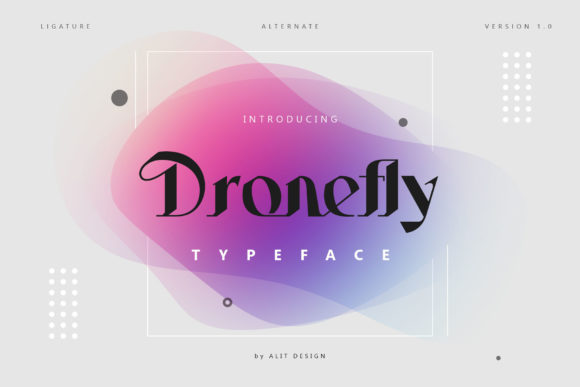
Dronefly: Elevating Visual Identity with Victorian Elegance
In the crowded landscape of digital and print design, standing out often comes down to a single element: typography. We live in an era where screens are saturated with clean, minimalist sans-serif fonts that prioritize readability above all else. While there is certainly a place for that aesthetic, there is a growing hunger for character, history, and distinct personality in visual communication. This is where Dronefly enters the conversation. It is not just another decorative typeface; it is a cool, Victorian-styled, assertive display font designed to command attention while maintaining a sense of refined sophistication.
If you are a creator, entrepreneur, or marketer looking to inject a bit of old-world charm into modern projects, Dronefly offers a unique solution. Its PUA (Private Use Area) encoding ensures that every glyph and swash is accessible with ease, allowing you to customize your text without wrestling with complex software workarounds. But beyond the technical specs, the real question is: how does this font translate into real-world value? Let’s explore where Dronefly shines and why it might be the missing piece in your design toolkit.
The Aesthetic Appeal of Victorian Typography
Victorian design is characterized by its ornate details, bold contrasts, and a certain theatrical flair. Dronefly captures this essence perfectly. It is assertive—meaning it doesn’t whisper; it speaks clearly and confidently. When you use this font, you are borrowing the visual language of the late 19th century, a time when signage, invitations, and advertisements were treated as art forms in their own right.
For designers, this style provides a powerful tool for differentiation. In a feed of generic templates, a headline set in Dronefly immediately signals quality and thoughtfulness. It suggests that the brand behind the message cares about aesthetics and detail. Whether you are designing a logo for a boutique coffee shop or a header for a lifestyle blog, the Victorian influence adds a layer of trust and heritage that modern geometric fonts often lack.
Real-World Applications for Dronefly
Understanding the "what" is easy, but knowing the "where" and "why" is what separates good design from great design. Here are several realistic scenarios where Dronefly can transform a project.
Branding for Lifestyle and Heritage Businesses
Consider the small business owner who runs an artisanal candle company, a vintage clothing store, or a specialty tea importer. These brands rely heavily on storytelling and atmosphere. A standard Helvetica font might communicate clarity, but it rarely communicates soul. By using Dronefly for the primary logo or key packaging elements, these businesses can visually align themselves with craftsmanship and tradition. Imagine a label on a jar of handmade jam featuring the product name in Dronefly’s elegant swashes—it instantly feels more premium and handcrafted than if it were set in a basic sans-serif.
Event Invitations and Print Collateral
Weddings, galas, and corporate retreats often require a specific tone. If you are organizing a formal event, the invitation is the first touchpoint with your guests. Dronefly’s Victorian roots make it an ideal choice for save-the-dates, menus, and programs. The assertive nature of the font ensures legibility even at smaller sizes, while the decorative elements add a touch of celebration. For educators or community organizers hosting historical reenactments or literary salons, this font bridges the gap between historical accuracy and modern readability.
Digital Content and Blog Headers
Bloggers and content creators are always fighting for click-through rates. Your headline is your hook. Using Dronefly for featured post titles or section headers can break the monotony of web pages filled with uniform text blocks. It draws the eye and encourages the reader to pause. For example, a travel blogger writing about European architecture could use Dronefly for city names or chapter titles, creating a cohesive visual theme that enhances the narrative journey. The PUA encoding allows you to mix and match glyphs to create unique headlines that feel custom-made rather than templated.
Social Media Graphics and Merchandise
Visual platforms like Instagram and Pinterest thrive on aesthetics. Small business owners selling t-shirts, mugs, or posters can leverage Dronefly to create products that stand out in a crowded marketplace. The font’s strong presence works well on merchandise because it remains readable even when scaled up or down. A freelancer designing social media templates for clients in the wellness or spirituality space might find that Dronefly adds a grounded, earthy elegance that resonates with audiences seeking authenticity.
Technical Ease and Creative Freedom
One of the most significant advantages of Dronefly is its accessibility. Many decorative fonts come with limited character sets or require third-party tools to access special ligatures and swashes. This can be a major bottleneck for users who are not professional typographers. Dronefly solves this problem through PUA encoding.
What does this mean for you? It means that once you install the font, you have direct access to all its features within any standard text editor or design software. You don’t need to hunt for hidden symbols or worry about compatibility issues. This ease of use empowers hobbyists and non-designers to experiment freely. You can try different combinations of letters and ornaments until you find the perfect look, confident that the tool is working for you, not against you.
- Immediate Access: No complex plugins or scripts needed to view the full range of glyphs.
- Consistency: The font behaves predictably across different platforms, ensuring your design looks the same on screen as it does in print.
- Creative Control: The ability to easily swap in swashes allows for rapid iteration and customization of your designs.
Things to Consider Before Using Dronefly
While Dronefly is a versatile and striking font, it is not a one-size-fits-all solution. Like any design tool, it requires thoughtful application to achieve the best results.
Readability vs. Decoration: Because Dronefly is a display font, it is best used for headlines, titles, and short phrases. Avoid using it for long body text. The intricate details that give it character can become muddy and difficult to read when set in paragraphs. Reserve the font for impact points where you want to grab attention.
Contextual Appropriateness: The Victorian style carries specific connotations. It may not be suitable for tech startups, medical facilities, or brands aiming for a futuristic or ultra-minimalist image. Ensure that the font aligns with your overall brand voice. If your brand is about speed and efficiency, Dronefly’s ornate nature might send the wrong message. However, if your brand is about quality, history, or luxury, it is a perfect match.
Color and Background: To fully appreciate the nuances of Dronefly, consider how it interacts with color. High contrast backgrounds, such as dark text on light paper or vice versa, tend to highlight the font’s sharp edges and curves. Experimenting with complementary colors can enhance the Victorian feel, perhaps pairing the font with deep greens, burgundies, or golds.
Conclusion
Dronefly is more than just a font; it is a stylistic statement. It offers creators, entrepreneurs, and everyday users a way to infuse their projects with a sense of history, elegance, and assertiveness. Whether you are designing a wedding invitation, branding a new product, or simply sprucing up your blog, Dronefly provides the visual weight and character needed to make your work memorable. With its user-friendly PUA encoding and rich Victorian aesthetic, it is a practical addition to any designer’s arsenal. Add it confidently to your favorite creations, and let yourself be amazed by the outcome generated.